BS 7671:2018+A3:2024/A4:2026
RCD, RCBO and AFDD types explained
Choosing the right residual current device is no longer a "any 30 mA RCD will do" job. Modern loads produce DC and high-frequency leakage that older Type AC devices simply can't see. Here's how Paul selects RCD, RCBO and AFDD types under BS 7671:2018+A3:2024/A4:2026.
RCD types by residual waveform
Type AC
Detects: Sinusoidal AC residual currents only.
Historically the default. Now considered inadequate for most modern loads because so many appliances have electronic front ends. BS 7671 Regulation 531.3.3 restricts its use to fixed equipment where no DC residual current is expected — do not select Type AC without confirming the load.
Type A
Detects: Sinusoidal AC and pulsating DC residual currents; a Type A RCD does not itself provide smooth-DC fault protection.
The new practical default for most domestic and commercial final circuits — sockets, lighting, immersion, most white goods and Class I appliances with switched-mode power supplies.
Type F
Detects: As Type A, plus higher-frequency and composite waveforms from single-phase variable-speed drives.
Circuits feeding single-phase inverter-driven equipment — many modern washing machines, tumble dryers, dishwashers and single-phase VSDs.
Type B
Detects: AC, pulsating DC, and smooth DC residual currents.
Mandatory (or a Type A with a DC-fault detection device) for most Mode 3 & 4 EV charge points — see Section 722. Also required by many three-phase VSDs and DC-coupled PV / battery systems where smooth DC leakage is possible.
RCBOs — what the letters mean
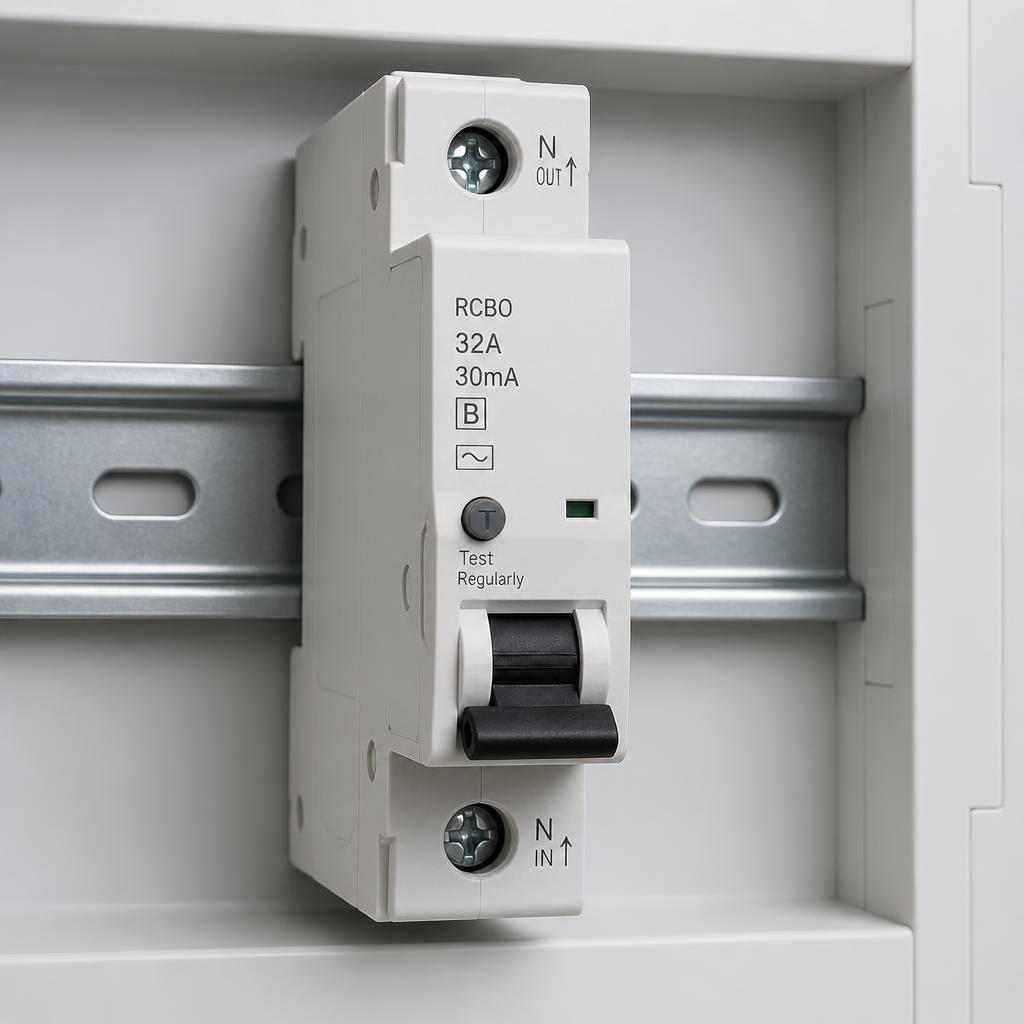
RCBO stands for Residual Current Circuit Breaker with Overcurrent protection. In plain English, it is an RCD (or RCCB) with built-in MCB protection in one unit. The residual-current side rapidly disconnects the supply when it detects an imbalance between the live and neutral currents — the sort of leakage that happens when someone touches a live part or a cable is damaged. The overcurrent side protects the cable against overload and short-circuit in the same way a normal MCB does.
Because an RCBO is fitted to each individual circuit, a fault on the kitchen sockets only trips the kitchen circuit. The lights, fridge, broadband and alarm stay on. That is why Paul recommends RCBOs as the default for modern consumer units.
- How it works
- The residual-current element monitors the current in the live and neutral conductors. If they differ by more than the rated residual current (usually 30 mA) it disconnects within the applicable time for the device and circuit; a 30 mA rating does not mean it trips at precisely 30 mA or always within 40 ms (a general-type device may take up to 300 ms at its rated residual current). The overcurrent element uses a bimetallic strip for sustained overloads and an electromagnet for short-circuit faults. RCBOs are covered by IEC/EN 61009.
- Typical rating
- 6 A – 45 A, B or C curve, 30 mA residual sensitivity, single-pole or 1P+N. Type A, F and B versions are available for inverter-driven loads, EV chargers and three-phase equipment.
- Where Paul uses them
- All domestic final circuits — excluding sub-mains where a suitably protected cable is already installed — and most industrial circuits, although some exclusions exist depending on the installation design.
- RCBO vs MCB
- An MCB only protects against overload and short circuit. An RCBO adds the residual-current protection of an RCD, so it also trips on earth leakage. That is the only meaningful difference — the MCB part of an RCBO behaves the same way as a standalone MCB.
- Uni-directional vs bi-directional
- A conventional RCBO is uni-directional — it is designed for power flow from the supply (line) side to the load side, and its internal arc-quenching and residual-current sensing are optimised for that direction. A bi-directional RCBO is rated to break fault current with power flowing either way, and is what Paul selects for circuits where the load itself can export current: solar PV inverters, battery storage inverters, EV chargers with V2H/V2G capability, and generator interconnections. Fitting a uni-directional device on a bi-directional circuit can result in the breaker failing to clear a fault when energy is flowing "backwards" from the battery / PV side.
- Single-pole vs double-pole isolation
- RCBOs come in two switching configurations. A single-pole + neutral (1P+N) switched RCBO may switch only the line conductor, with a solid neutral, or may have a switched neutral; check the maker's markings and instructions. A double-pole (2P) switched RCBO breaks both line and neutral. Select the device to meet the installation's isolation and fault-protection requirements, especially for TT arrangements; a bathroom or shower circuit does not by itself make a double-pole RCBO mandatory.
- RDC-PD — Residual DC Protective Device
- RDC-PD stands for Residual Direct Current Protective Device (BS EN 62955). It is a small in-line device that detects smooth DC residual currents above 6 mA and disconnects the circuit — the exact fault mode a Type A RCD cannot see. Its purpose is to allow a Type A RCD to be used upstream in situations that would otherwise require a full Type B RCD, principally Mode 3 EV charge points under BS 7671 Section 722. Many modern EV chargers have an RDC-PD (or DC-fault detector) built into the unit, which is why the installation manual will state that a Type A 30 mA RCD upstream is acceptable. Where no built-in RDC-PD is claimed by the charger manufacturer, a Type B RCD/RCBO is mandatory for the charger circuit.
- Functional earthing and conductor colours
- Some electronic devices — including certain RCBO / SPD combinations, Class I ICT equipment, EV charge point controllers and PV / battery inverters — require a functional earth (FE) in addition to the normal circuit protective conductor. A functional earth is not a safety earth: it exists to give the device's internal electronics a stable reference (for filtering, EMC, or open-PEN detection) and its disconnection would not create a shock hazard, only a functional failure. Never re-purpose a functional earth as a CPC, and never leave one disconnected because "it isn't the safety earth" — the device may then fail to detect an open-PEN condition or a DC leakage fault.
- Green-and-yellow — Protective conductor (CPC, main earthing conductor, bonding). Never re-purpose.
- Pink — Functional earth conductor. Used to mark FE terminals and sleeving so an engineer can tell it apart from the safety earth at a glance.
Colour identification (BS 7671)
How UK consumer units have evolved
The layout of the fuse board itself has changed almost as much as the devices inside it. Understanding which generation is on the wall helps explain why a single fault can take out half a house — or just one circuit.
1. Split-load consumer units (late 1980s – early 2000s)
A single 30 mA RCD protected one bank of MCBs — typically sockets and anything feeding outdoors — while the other bank (lights, cooker, immersion, alarms) ran on MCBs alone with no earth-leakage protection. Better than nothing, but a fault on any protected circuit tripped the whole RCD side.
2. Dual-RCD boards (BS 7671:2008, 17th Edition)
Amendment 1 of the 17th Edition effectively required additional protection by 30 mA RCD on most final circuits. Boards were split into two RCD banks so a fault only knocked out half the circuits — but lights and sockets in the same room were deliberately placed on different RCDs so you were never left completely in the dark.
3. High-integrity dual-RCD boards
An evolution of the dual-RCD design with three neutral bars: two RCD-protected and one dedicated to a non-RCD section. Fire alarms, burglar alarms, freezers and other circuits where nuisance tripping is unacceptable could sit on RCBOs in the non-RCD section, keeping them independent of the two shared RCDs.
4. All-RCBO boards (BS 7671:2018 onwards — today's default)
Every final circuit gets its own RCBO — full discrimination, so a fault on one circuit only affects that circuit. This is what Paul fits on new installations and consumer unit changes, typically with Type A or Type F RCBOs and, where required by BS 7671:2018+A3:2024/A4:2026, AFDDs as well.
AFDDs — Arc Fault Detection Devices
AFDD stands for Arc Fault Detection Device. A modern AFDD combines the functions of overcurrent, residual-current and arc-fault protection in some models; other AFDDs need separate protective devices, and widths vary by model. It trips on overload, short circuit and earth leakage like an RCBO, but it also "listens" to the current waveform with a microprocessor. When it recognises the signature of a dangerous arc — the tiny plasma discharge caused by worn contacts, damaged insulation, a break in a cable or a loose connection — it disconnects the circuit before the arc can ignite surrounding material. Arc temperatures can exceed 6,000 °C, so early disconnection is what prevents fire.
AFDDs are far more sensitive to arcing than conventional MCBs, RCDs or RCBOs. They ignore the harmless arcs produced by normal switching, motors and appliances, but react to the sustained, irregular arcs that start fires. Like RCDs and RCBOs, AFDDs incorporate a test button to prove the mechanical operation of the device.
Under BS 7671:2018+A3:2024/A4:2026 Regulation 421.1.7, AFDDs to BS EN 62606 are required on single-phase AC final circuits ≤32 A supplying socket-outlets in:
- Higher-risk residential buildings (HRRB),
- Houses in multiple occupation (HMOs),
- Purpose-built student accommodation, and
- Care homes.
For all other premises — including ordinary domestic homes — AFDDs are recommended. They are especially worth considering where there is sleeping accommodation, combustible construction, fire-propagating structures such as timber frames or thatch, or irreplaceable contents. Paul routinely offers them on rewires and consumer unit changes because they close a real fire-risk gap that MCBs and RCDs cannot.