Construction, typical uses, suitable premises and published current ratings — with the conditions that matter.
Source check: 14 November 2026. A cable has no single universal amp rating. The figures below are reference data, not a recommended fuse or circuit-breaker size.
Twin-and-earth: 1–16 mm²
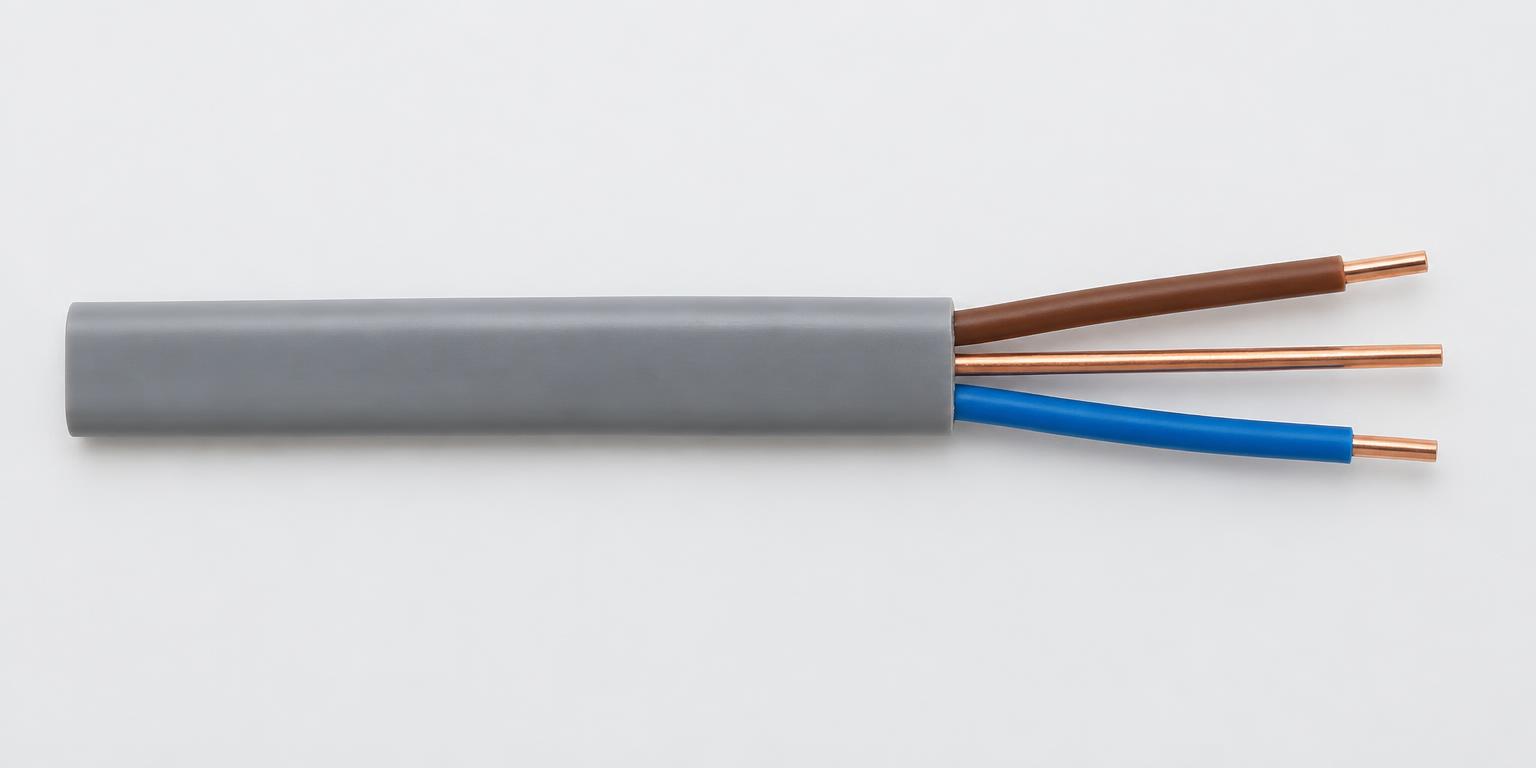
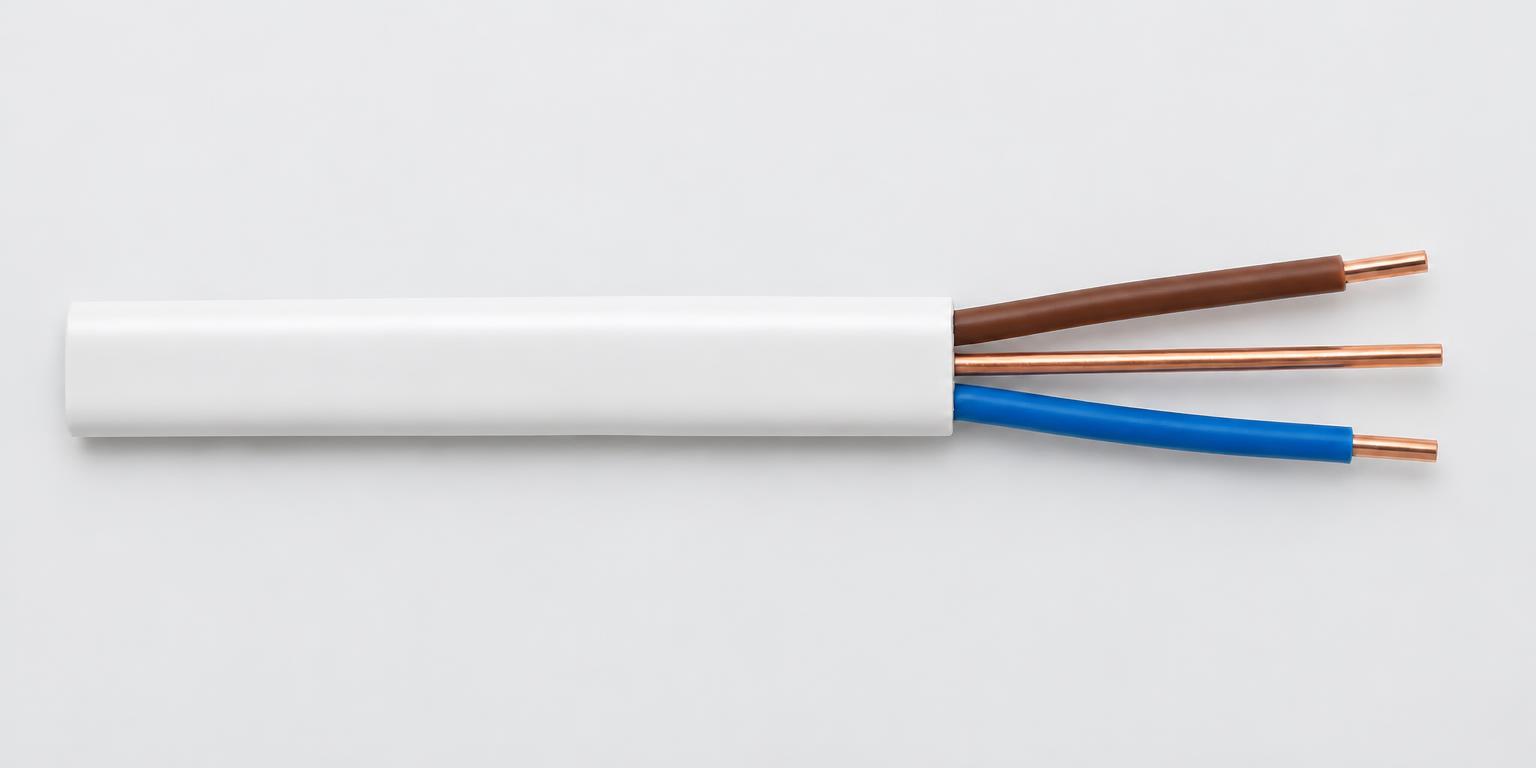
Two insulated copper conductors plus a bare circuit protective conductor (CPC), inside a flat sheath. The size in mm² is the cross-sectional area of each insulated conductor, not the cable’s diameter. The CPC is often smaller.
Premises: Prysmian specifies fixed installations in domestic, commercial and industrial premises: houses, flats, offices, shops and suitable industrial building wiring. This is not blanket approval for machinery, harsh chemicals, explosive atmospheres, exposed outdoor runs or burial. Fire strategy, mechanical protection and the actual product specification still govern.
Small-size construction: solid copper cores and a bare solid CPC, as in the referenced 1 and 1.5 mm² products. Not a size comparison; larger 4–16 mm² insulated conductors are stranded.
Brown
Normally line. Switch drops may carry permanent and switched lines instead of a line and neutral.
Blue
Normally neutral. When used as line, identify it with brown sleeving or marking at its terminations.
Bare CPC
Protective earth, sleeved green-and-yellow where exposed at terminations. Never use it as a live conductor.
1 mm²
Twin-and-earth
CPC: 1 mm²
A small fixed-wiring cable with two 1 mm² insulated copper conductors and a bare protective conductor.
Solid insulated conductors · Referenced standard UK construction; confirm the actual product.
Intended / usual uses: Lighting circuits, ceiling roses, suitable light fittings, one-way switch drops and mains supplies to domestic smoke/heat detectors where the circuit design and alarm manufacturer's instructions permit.
Important: Not the normal choice for general socket or high-load circuits. Hard-wired alarm interconnection may need three-core-and-earth or another manufacturer-specified cable; never use the CPC as an interconnect conductor.
1.5 mm²
Twin-and-earth
CPC: 1 mm²
A slightly larger lighting cable with two 1.5 mm² insulated copper conductors.
Solid insulated conductors · Referenced standard UK construction; confirm the actual product.
Intended / usual uses: Lighting circuits and switch drops; mains supplies to domestic smoke/heat detectors and selected fixed supplies to low-load equipment where the circuit design and equipment manufacturer's instructions permit.
Important: May be chosen instead of 1 mm² because of the circuit design or specification; it is not automatically adequate for every lighting run. Hard-wired alarm interconnection may need three-core-and-earth or another manufacturer-specified cable; never use the CPC as an interconnect conductor.
2.5 mm²
Twin-and-earth
CPC: 1.5 mm²
A common small-power cable with two 2.5 mm² insulated copper conductors and a smaller CPC.
Solid insulated conductors · Referenced standard UK construction; confirm the actual product.
Intended / usual uses: Domestic ring-final socket circuits, appropriately designed socket radials, and some dedicated appliance supplies.
Important: A 32 A ring final has specific design conditions; 2.5 mm² does not automatically mean a 32 A radial.
4 mm²
Twin-and-earth
CPC: 1.5 mm²
A larger fixed-wiring cable with two stranded 4 mm² insulated copper conductors.
Stranded insulated conductors · Referenced standard UK construction; confirm the actual product.
Intended / usual uses: Designed socket radials and dedicated appliance circuits; some cooking or heating supplies depending on load and installation conditions.
Important: Not a universal cooker cable. Check appliance demand, route, protection and terminal capacity.
6 mm²
Twin-and-earth
CPC: 2.5 mm²
A heavier fixed-wiring cable with two stranded 6 mm² insulated copper conductors.
Stranded insulated conductors · Referenced standard UK construction; confirm the actual product.
Intended / usual uses: Some cooker and hob circuits, selected shower circuits and other dedicated higher-load supplies where calculations permit.
Important: A shower’s power rating alone does not establish suitability; insulation and cable length can require a larger size.
10 mm²
Twin-and-earth
CPC: 4 mm²
A substantial fixed-wiring cable with two stranded 10 mm² insulated copper conductors.
Stranded insulated conductors · Referenced standard UK construction; confirm the actual product.
Intended / usual uses: Some higher-load shower, cooking and electric-heating circuits, and selected internal distribution supplies.
Important: Not automatically suitable for any shower, EV charger or outbuilding supply; assess the equipment, route and protective arrangements.
16 mm²
Twin-and-earth
CPC: 6 mm²
The largest size in the standard twin-and-earth range referenced here, with two stranded 16 mm² insulated conductors.
Stranded insulated conductors · Referenced standard UK construction; confirm the actual product.
Intended / usual uses: Designed higher-current fixed circuits and some protected internal submains or distribution supplies.
Important: Not a substitute for meter tails, armoured cable or a calculated submain design; the reduced CPC must also satisfy fault-protection requirements.
PVC twin-and-earth: published current capacity
Eland’s 624-Y data sheet reproduces Table 4D5: 70°C conductor temperature, 30°C ambient. Method C is clipped direct; Method A is enclosed in conduit in an insulated wall. These figures are before applicable correction factors. Prysmian’s 6242Y sheet directs designers to Table 4D5 rather than printing its own amp figures.
1 mm²
16 A — Method C
11.5 A — Method A
1.5 mm²
20 A — Method C
14.5 A — Method A
2.5 mm²
27 A — Method C
20 A — Method A
4 mm²
37 A — Method C
26 A — Method A
6 mm²
47 A — Method C
32 A — Method A
10 mm²
64 A — Method C
44 A — Method A
16 mm²
85 A — Method C
57 A — Method A
Thermal insulation, grouping and temperature can reduce capacity significantly. The downloaded Eland sheet has inconsistent entries in some insulation-method columns; those columns are deliberately not reproduced. Consult the current standard and manufacturer before design.
Three-core-and-earth
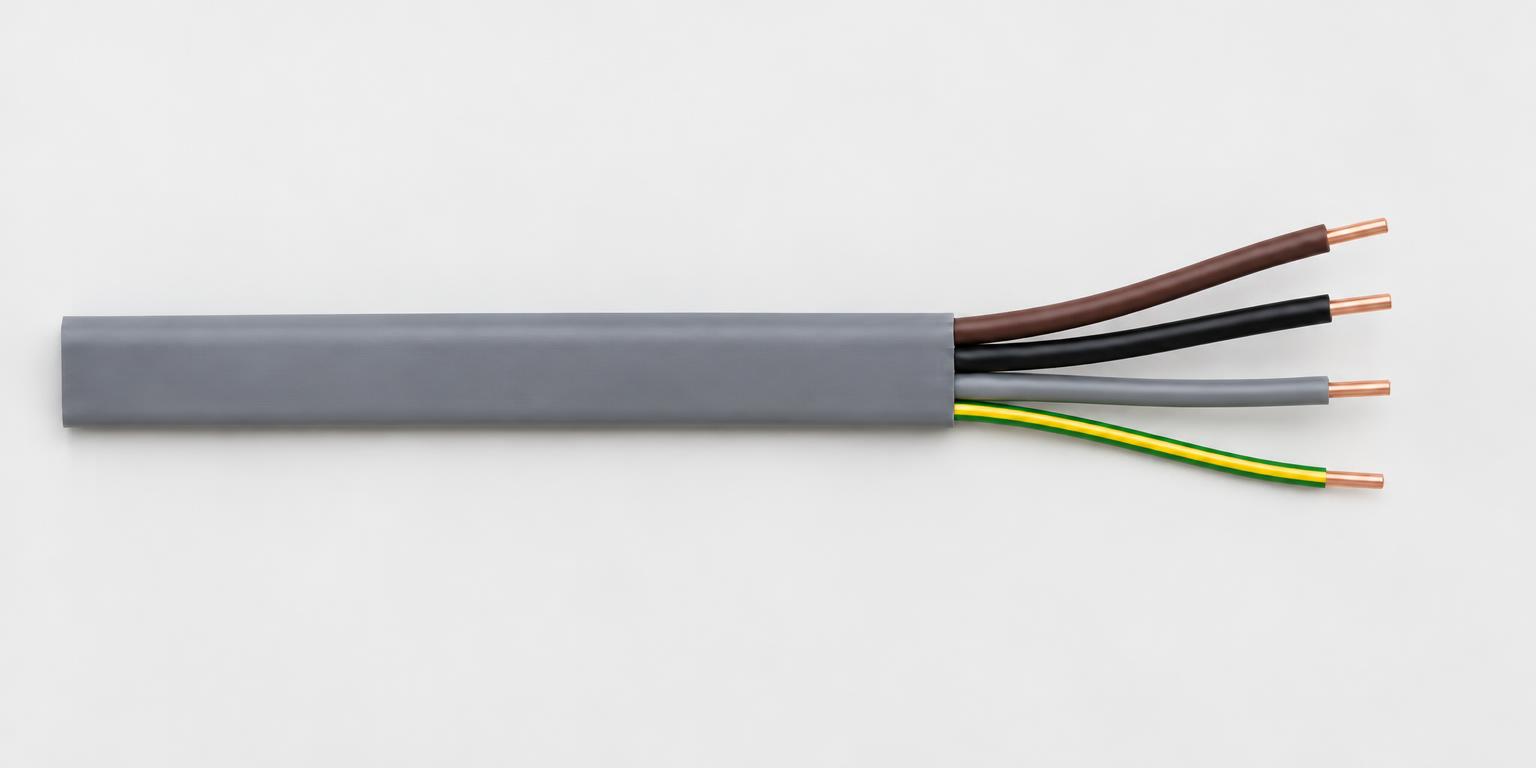
Three insulated conductors plus a bare CPC. Useful when a circuit needs an additional live or control conductor, not simply a bigger cable. The common fixed-wiring sizes in the referenced supplier range are 1 and 1.5 mm².
Premises: domestic and suitable commercial fixed lighting/control wiring in dry or damp indoor locations, with protection appropriate to the route. A public building or industrial site may specify a different sheath, fire performance or wiring system.
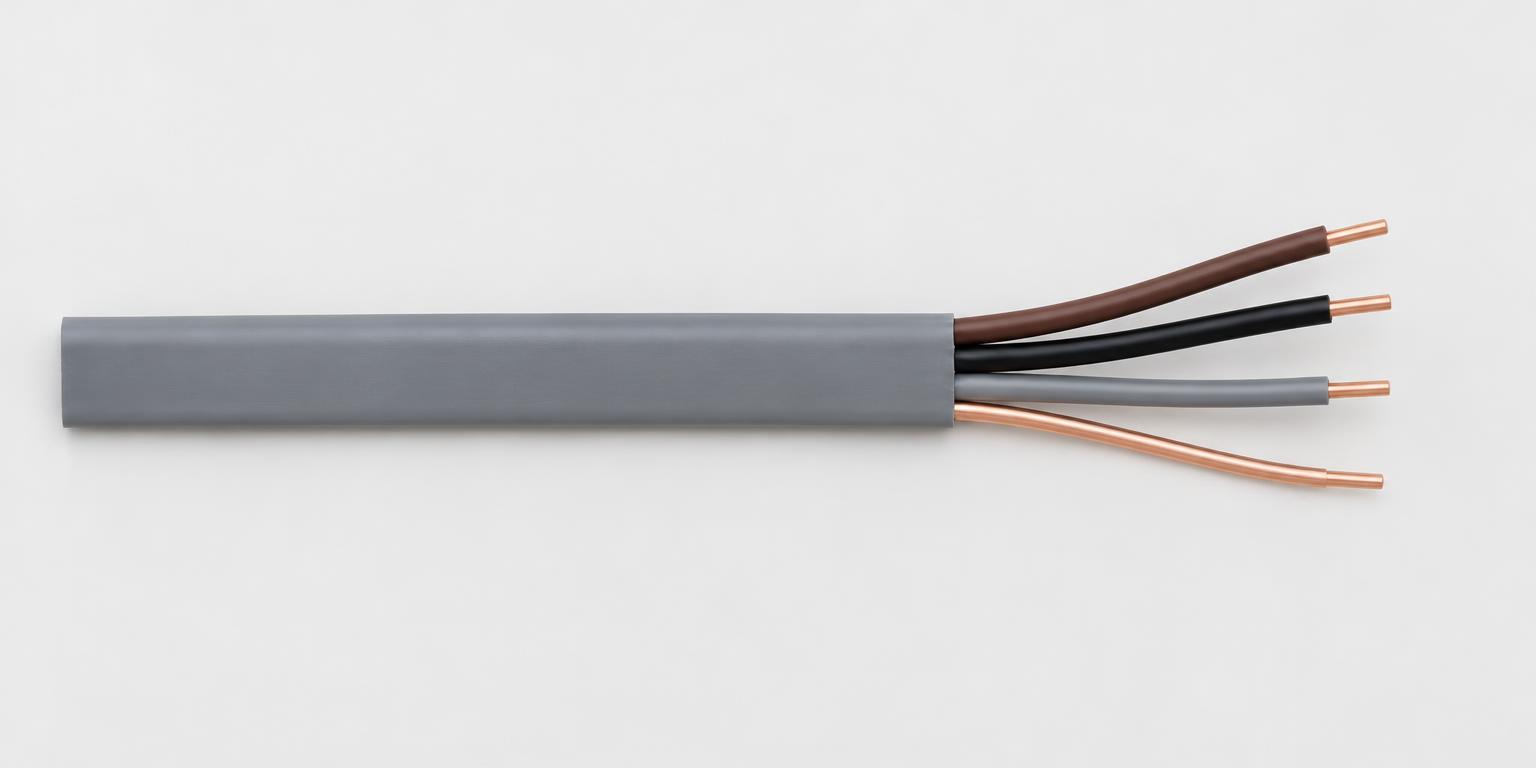
Illustrative 1 or 1.5 mm² construction: three solid insulated copper cores plus one bare solid CPC. Core positions and dimensions are illustrative.
Identify by function: brown, black and grey are the usual core colours. There is no blue insulated core as supplied. Sleeve or mark a core blue if it is used as neutral, and identify line conductors appropriately at terminations. There is no universal black/grey function for every control circuit.
1 mm²
Three-core-and-earth
CPC: 1 mm²
Three 1 mm² insulated copper conductors, normally brown, black and grey, plus a bare copper CPC.
Intended / usual uses: Two-way and intermediate lighting switch links; suitable fan supplies needing permanent line, switched line and neutral; selected lighting controls.
Important: Its extra core provides another conductor, not extra current capacity. A timer fan may need three-pole isolation according to its instructions and installation.
1.5 mm²
Three-core-and-earth
CPC: 1 mm²
Three 1.5 mm² insulated copper conductors, normally brown, black and grey, plus a bare copper CPC.
Intended / usual uses: Two-way and intermediate lighting switch links, timer-fan wiring and selected fixed heating or control wiring where three insulated conductors are needed.
Important: Heating and smart controls may need more than three conductors. Follow the equipment diagram rather than assuming this cable will suit.
Larger three-core-and-earth products may be available from particular suppliers. Do not assume the complete twin-and-earth size range exists in the same construction; obtain the specific manufacturer’s data. Three-core-and-earth is not automatically suitable for three-phase power.
Current capacity: check the loaded conductors
The linked Eland family sheet prints a Table 4D5 table, but does not provide a separately identified rating for a 6243Y arrangement with all three cores loaded. No verified all-three-loaded amp figure is claimed here for either 1 or 1.5 mm². Do not copy the twin-and-earth figures into a three-phase or different control arrangement without manufacturer confirmation. For the white Prysmian 6243B variant, its manufacturer explicitly references Table 4E2 and warns about equipment temperature compatibility.
Material and colour variants
PVC: 6242Y / 6243Y
6242Y has two insulated cores; 6243Y has three. Both include a bare CPC. These are ordinary PVC fixed-wiring cables to BS 6004, commonly with a grey sheath. White sheaths are also available for some products. Sheath colour does not set current capacity.
Usual use: domestic and commercial fixed power, lighting and control wiring where the cable specification and installation conditions permit.
Low-smoke, zero-halogen: 6242B / 6243B
The two-core and three-core equivalents to BS 7211 use thermosetting insulation and a low-smoke, zero-halogen sheath. The referenced Prysmian 6242B has XLPE insulation and a white sheath; check each product’s size range.
Usual use: fixed wiring where the specification calls for reduced smoke and corrosive gas emissions. LSZH is not the same as fire-resistant circuit-integrity cable, and is not automatically mandatory for every home.
A 90°C cable rating does not automatically allow 90°C operation at accessories: verify terminal and equipment temperature limits before using higher-temperature ratings.
Twin brown switching cable
Some 1 and 1.5 mm² twin-and-earth products are supplied with two brown insulated cores instead of brown and blue.
Usual use: switching arrangements needing permanent and switched lines, avoiding a blue core being mistaken for neutral. Verify the circuit functions and actual product marking.
Older colour variants
Older twin-and-earth may have red and black cores; older three-core-and-earth may have red, yellow and blue. Colour identifies the era, not the cable’s condition or whether it is safe.
Doncaster Cables’ EarthSure replaces the exposed bare CPC found in conventional twin-and-earth with a factory-applied green-and-yellow insulative covering. It saves fitting separate identification sleeving over that covered length; any copper exposed beyond a terminal still needs appropriate protection and identification. This is fixed-wiring cable, not flexible appliance cable, and the CPC remains exclusively a protective conductor.
Construction and approval: plain annealed copper, PVC live-core insulation and an EarthTek sheath, rated 300/500 V and 70°C maximum operating temperature. Doncaster identifies BASEC Certificate of Assessed Design 052, with mechanical and electrical requirements equivalent to conventional BS 6004 cable. It is more accurate to cite CAD 052 than assume it is identical in construction to bare-CPC 6242Y/6243Y.
Premises: the manufacturer specifies domestic and light-industrial fixed wiring in dry or damp premises. Its listed routes include conduit, trunking, ducting, tray, clipped direct, embedded and free air, with appropriate mechanical protection. It is explicitly not intended for underground installation. This PVC range is not the white LSZH cable below and is not fire-resistant circuit-integrity cable.
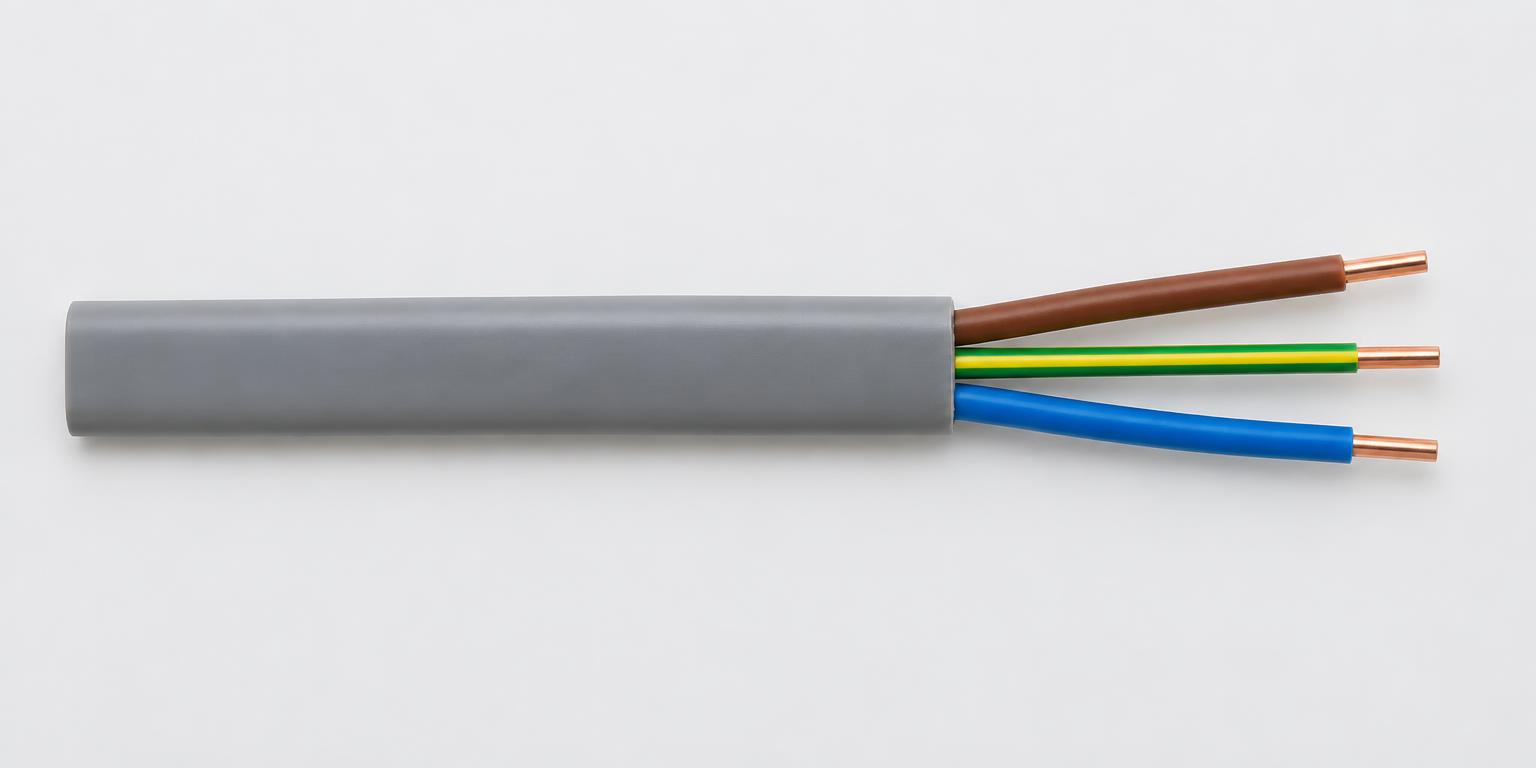
Twin-and-earth: brown, blue and covered CPC
Illustrative small-size EarthSure construction, not a manufacturer photograph or termination example. The smaller CPC has factory-applied green-and-yellow covering; all three copper cores shown are solid.
Typical uses: designed lighting and power circuits, following the size-specific uses above. Suitable 1 and 1.5 mm² products can supply domestic mains smoke/heat detectors where the alarm instructions and circuit design permit; an interconnect needs a separate manufacturer-specified conductor, never the CPC.
1 mm²
CPC 1 mm² · solid
Live cores: solid (Class 1)
1.5 mm²
CPC 1 mm² · solid
Live cores: solid (Class 1)
2.5 mm²
CPC 1.5 mm² · solid
Live cores: solid (Class 1)
4 mm²
CPC 1.5 mm² · solid
Live cores: stranded (Class 2)
6 mm²
CPC 2.5 mm² · solid
Live cores: stranded (Class 2)
10 mm²
CPC 4 mm² · stranded
Live cores: stranded (Class 2)
16 mm²
CPC 6 mm² · stranded
Live cores: stranded (Class 2)
Unlike the generic construction described earlier, this manufacturer’s 10 and 16 mm² EarthSure CPCs are stranded too. Always check the actual product, not just the nominal size.
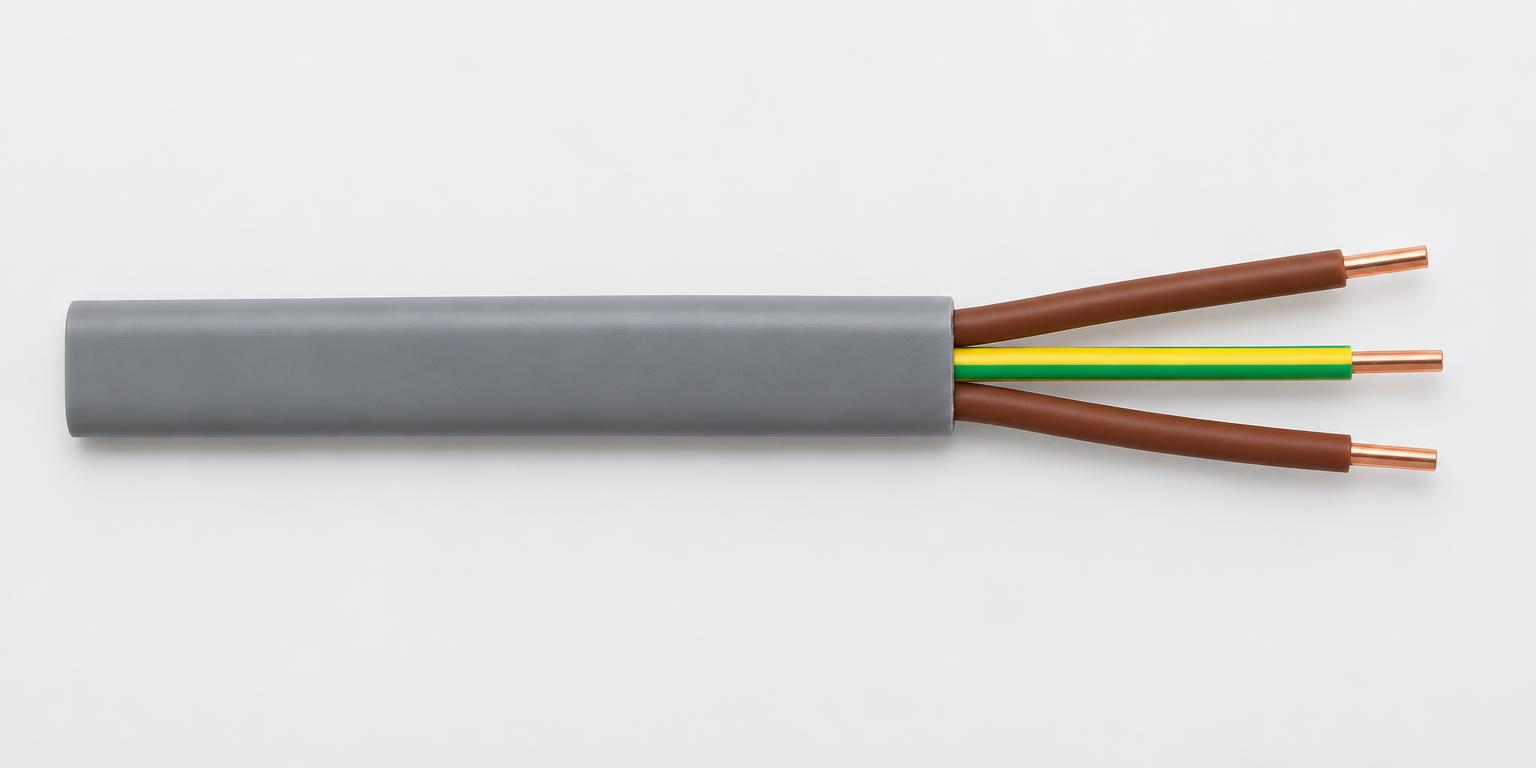
Twin brown: switching variant
Illustrative 1.5 mm² twin-brown variant: two line-coloured cores and a covered protective conductor; there is no blue neutral core as supplied.
Doncaster lists a 1.5 mm² twin-brown version with a 1 mm² CPC. Typical use is a permanent-line/switched-line link where the circuit design permits. Two brown cores do not establish which one is permanent or switched line: trace and identify their functions, and do not assume a neutral is present.
Three-core-and-earth: lighting and control links
Illustrative four-conductor arrangement: three solid live/control cores plus a smaller solid covered CPC. Positions and dimensions are illustrative, not a manufacturer cross-section.
The verified sizes are 1 mm² with 1 mm² CPC and 1.5 mm² with 1 mm² CPC; all are solid conductors. Typical applications include two-way/intermediate switch links, suitable timer fans and manufacturer-approved alarm interconnections. Brown, black and grey do not define universal functions; identify a neutral blue where one is used. The green-and-yellow CPC must never serve as an interconnect or control wire.
Current capacity: the manufacturer references Table 4D5
Doncaster’s EarthSure sheet directs designers to BS 7671 Table 4D5 rather than giving a new set of amp figures. The source-labelled PVC twin-and-earth table above provides Method C and Method A reference figures for the applicable two-loaded-conductor arrangement, on a 70°C conductor / 30°C ambient basis before corrections. A covered CPC does not create extra current capacity or change the required circuit checks. Do not apply those twin figures to an unverified all-three-loaded arrangement.
EarthSure is an available product variant, not a blanket requirement to replace serviceable conventional twin-and-earth. Correct CPC continuity, identification, terminations, fault protection and circuit design are still essential; the covering does not remove PME or diverted-neutral precautions.
White 6242B low-smoke, zero-halogen cable
Small-size white 6242B construction, representing 1 or 1.5 mm² solid-core cable. The linked 10 mm² product has stranded insulated conductors; this is not its size-specific photograph.
The TLC CA10LSF product you linked is 10 mm² twin-and-earth with XLPE insulation, a white LS0H polyolefin sheath and a bare 4 mm² CPC. It is not simply grey PVC cable painted white. The linked La Triveneta Cavi sheet (ST-101-001-E, revision 0, 17 November 2011) describes the 6242BH family to BS 7211:1998 and a maximum operating temperature of 90°C; confirm the actual reel’s manufacturer and current declaration before specifying it.
Premises: fixed wiring in homes, flats, offices and other buildings where the specification calls for reduced smoke and corrosive gas emissions. The manufacturer particularly recommends it for fire-risk areas with many occupants, such as suitable school, healthcare and public-building installations. This is an application description, not blanket approval for every escape route or safety circuit.
The linked sheet permits fixed dry/humid applications and outdoor installation on buildings/metal structures, with solar-radiation resistance. That permission is product-specific: confirm exposure and mechanical protection; it is not permission for direct burial or an unprotected garden supply. LSZH does not mean fire-resistant circuit integrity, and white colour alone does not identify the cable specification.
1 and 1.5 mm² usual uses: lighting circuits and mains supplies to domestic smoke/heat detectors, where the circuit design and alarm manufacturer's instructions permit. This also applies to suitable grey or white PVC twin-and-earth of these sizes. Hard-wired alarm interconnection may need three-core-and-earth or another manufacturer-specified cable; never use the CPC as an interconnect conductor. These examples do not approve ordinary twin-and-earth for a fire-alarm system that requires fire-resistant cabling.
TLC publishes the following figures. Its linked manufacturer sheet does not state current capacities, and the product pages do not identify the installation method, ambient temperature or basis of these amp figures. They are supplier-listed figures, not independently verified manufacturer design ratings, and must not be compared directly with the Method C tables.
Do not use a 90°C rating at 70°C-only terminals unless the connected equipment and design permit it. Choose the appropriate temperature-limited rating and all correction factors; the listed 53 A does not automatically approve a 53 A load or protective device.
Flexible cable: choose the duty as well as the size
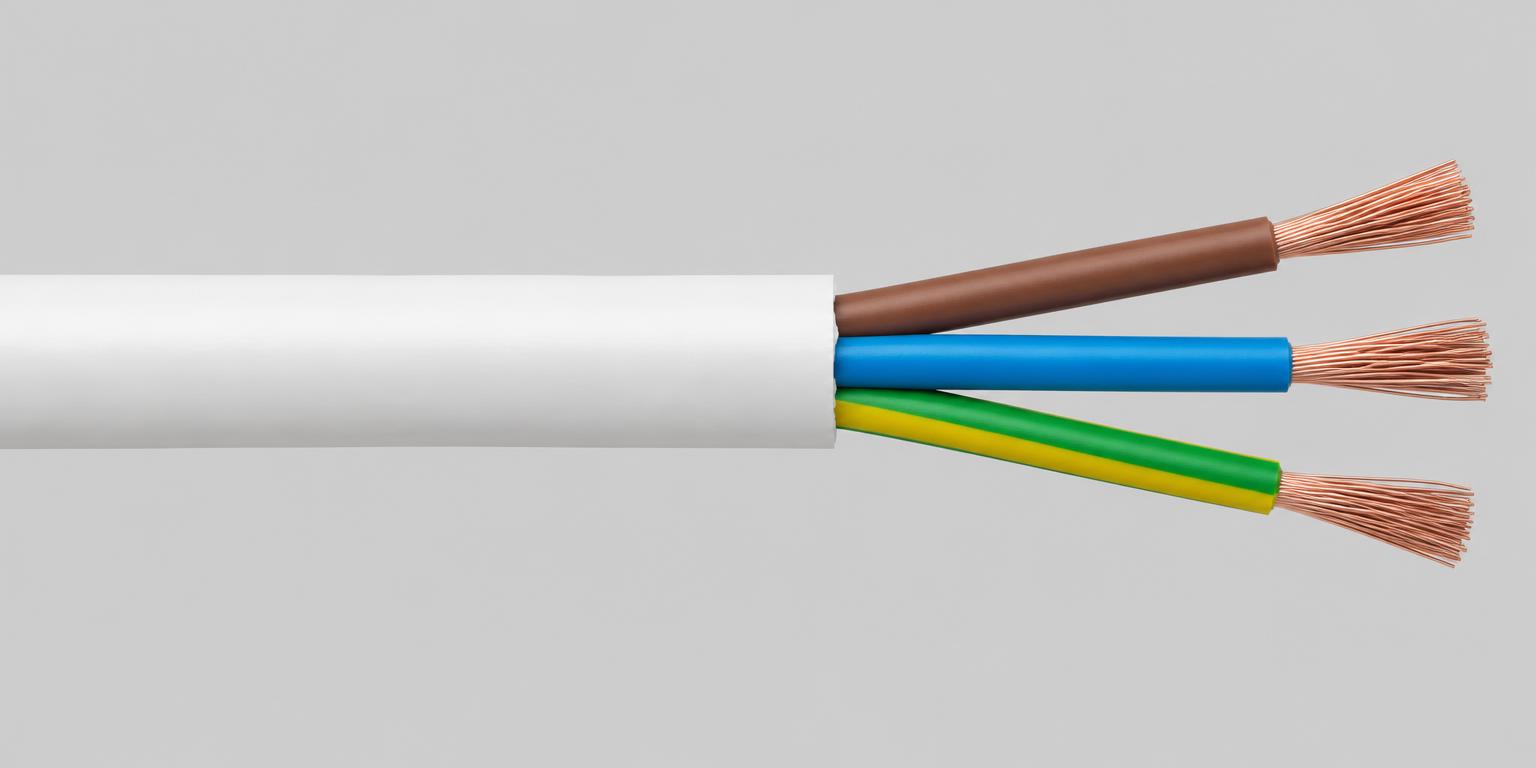
Three-core appliance flex: fine-stranded copper, not solid cores. The green-and-yellow protective conductor is insulated; there is no separate bare CPC. Illustrative construction, not a stripping or termination example.
Flex uses many fine copper strands (typically Class 5), allowing movement. Ordinary 318-Y / H05VV-F has PVC insulation and sheath, a 300/500 V rating and, in Eland’s sheet, a flexed temperature range of +5°C to +70°C. Two-core flex has no protective conductor: use only where the equipment’s protective arrangement permits it, not to omit the earth from Class I equipment.
Premises and uses: domestic appliances, kitchens, offices, table lamps and office equipment. Eland describes this ordinary PVC flex as generally unsuitable for outdoor use or industrial applications. Fine strands alone do not make a cable suitable for continuous machine movement, immersion or heat.
H05VV-F: Eland’s published current capacity
Eland reproduces Table 4F3A flexible-cord ratings, with 60°C rating-basis conductor temperature and 30°C reference ambient (not the cable’s 70°C material maximum). Apply the data sheet’s ambient-temperature reductions and relevant grouping/installation corrections. Single-phase and three-phase loading are different; these are not 13 A plug or extension-reel ratings.
0.75 mm²
6 A — single-phase
6 A — three-phase
1 mm²
10 A — single-phase
10 A — three-phase
1.5 mm²
16 A — single-phase
16 A — three-phase
2.5 mm²
25 A — single-phase
20 A — three-phase
4 mm²
32 A — single-phase
25 A — three-phase
Light-duty H03VV-F / 218-Y
Eland identifies this 300/300 V PVC flex for light portable equipment in homes, kitchens and offices, including table lamps and radios. It is not interchangeable with heavier-duty flex solely because the conductor size matches.
Arctic PVC and rubber flex
Arctic PVC is described by Eland for temporary outdoor and low-temperature extension-lead applications; it is not ordinary indoor PVC flex. Rubber types such as H07RN-F may be specified for tougher outdoor or industrial duties, but check the actual maker’s temperature, oil, UV, water and movement limitations. No unverified current figures for these separate families are claimed here.
Match the flex, plug, fuse, connectors and appliance instructions; the lowest applicable limit governs. Use suitable strain relief and strand-compatible terminals. Fully unwind reels when required by their marked ratings; a coiled reel may have a much lower capacity. Flex is not an automatic replacement for fixed building wiring.
Armoured cable: SWA power and distribution
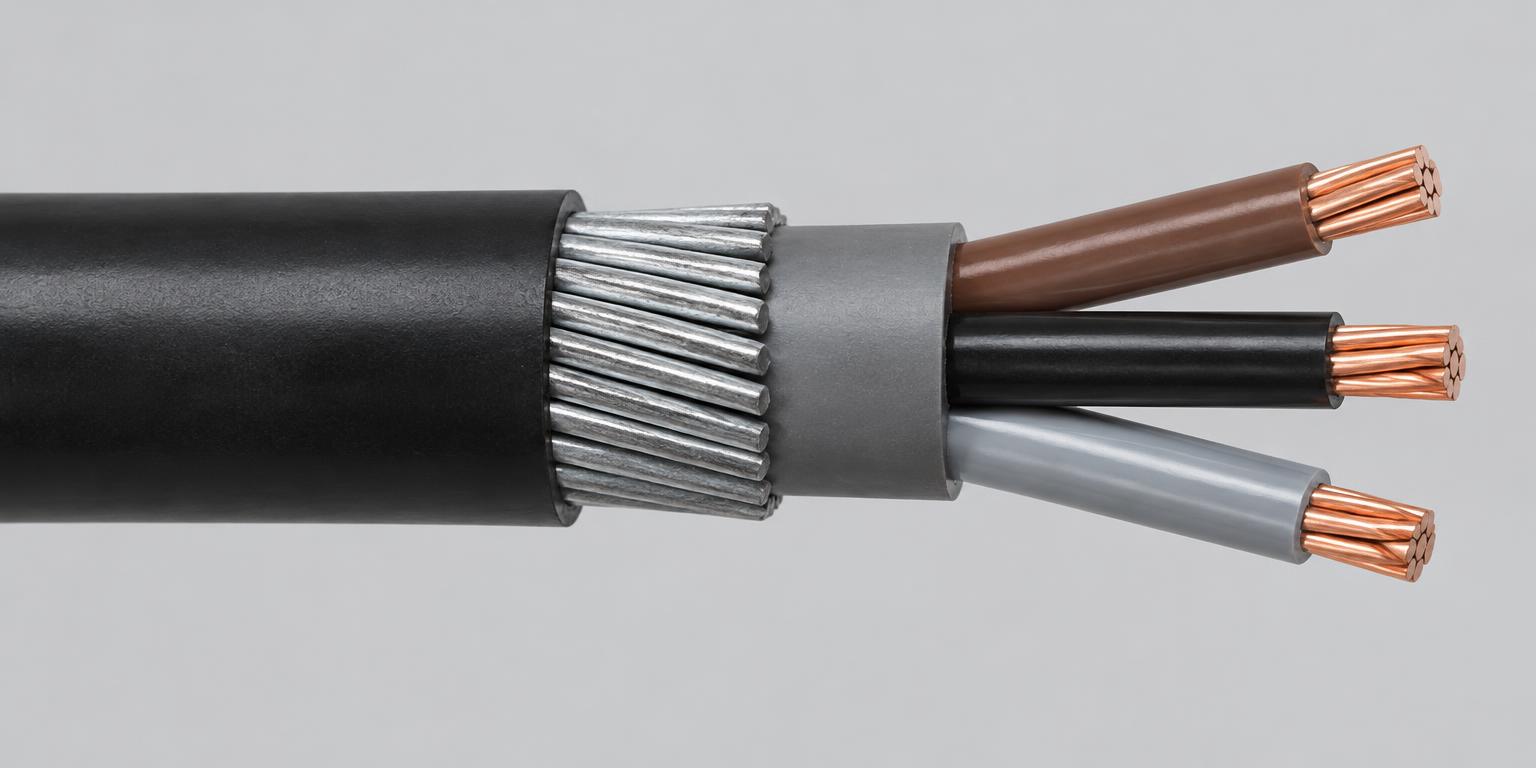
Illustrative three-core SWA: black outer sheath, steel armour around inner bedding, and three stranded copper cores. The silver armour wires are not the copper conductors. Colour functions depend on the circuit; this is not a completed gland or termination.
The referenced BS 5467 multi-core cable has Class 2 copper conductors, XLPE insulation, PVC bedding, steel wire armour (SWA) and a black PVC outer sheath. Its rating is 0.6/1 kV, with a maximum conductor temperature of 90°C. BS 6724 low-smoke armoured cable is a different specification; ordinary PVC-sheathed SWA is not LSZH.
Premises and uses: designed fixed supplies in domestic, commercial and industrial premises, including outbuildings, workshops, distribution boards and outdoor power networks. Eland specifies indoor, outdoor, underground and duct applications for this product. Burial depth, soil conditions, mechanical protection, warning identification and the route still require design; armour does not remove those duties.
BS 5467: Eland’s published Method C ratings
One cable, clipped direct (Method C), 30°C air, 90°C conductor basis, before correction factors. The first column is a two-core single-phase AC/DC cable; the second is three- or four-core three-phase AC. Do not apply the second column automatically to a three-core single-phase cable with a CPC. These are not buried-cable ratings.
1.5 mm²
27 A — two-core, single-phase / DC
23 A — three/four-core, three-phase
2.5 mm²
36 A — two-core, single-phase / DC
31 A — three/four-core, three-phase
4 mm²
49 A — two-core, single-phase / DC
42 A — three/four-core, three-phase
6 mm²
62 A — two-core, single-phase / DC
53 A — three/four-core, three-phase
10 mm²
85 A — two-core, single-phase / DC
73 A — three/four-core, three-phase
16 mm²
110 A — two-core, single-phase / DC
94 A — three/four-core, three-phase
25 mm²
146 A — two-core, single-phase / DC
124 A — three/four-core, three-phase
The same sheet gives different Method D1 (duct in ground) and D2 (direct buried) figures based on 20°C ground, 2.5 K·m/W soil thermal resistivity and 0.7 m depth. Changing those conditions changes the result. Larger sizes exist; the list here is an introductory 1.5–25 mm² range, not the whole catalogue.
Terminations and earthing: use suitable glands, enclosures and protective connections. Whether the armour is sufficient as a CPC must be verified by fault-protection calculations; an insulated CPC may be needed. Outbuilding earthing and PME/diverted-neutral risks need a separate assessment. Single-core AC armoured cables generally require non-magnetic armour such as AWA, not this multi-core SWA construction.
The manufacturer warns that 70°C-only connected accessories require the equivalent 70°C thermoplastic ratings (Table 4D4A), not these higher 90°C figures. Its sheet includes older-edition regulation references; check BS 7671:2018+A4:2026 for the current design requirements.
Check the circuit, not just the cable
This guide explains typical uses; it does not approve an installation. Load, installation method, insulation, grouping, ambient temperature, cable length, voltage drop and fault protection all affect selection. No single amp rating or breaker size applies to a cable in every situation. Fixed wiring cable is not appliance flex, and ordinary twin-and-earth is not a blanket choice for exposed outdoor or buried supplies. Never identify a conductor solely by colour, and safely isolate and prove dead before electrical work.